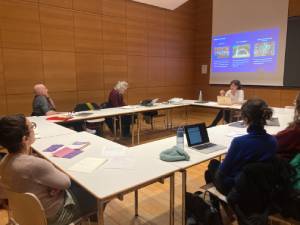
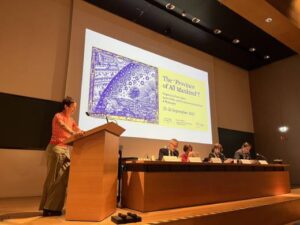
The ENS’s prestigious Lettres library hosted the launch of the Space chair on February 1, an event you can now watch on Savoirs ENS.
Raising awareness among a wide audience
“The entire value chain of the French space industry supports this Chair,” emphasized Stéphane Israël, President of the ENS Foundation and CEO of Arianespace.
Nine organizations (ArianeGroup, Airbus, ThalèsAlenia Space, Safran Data Systems, Air Liquide, Sodern, Eutelsat, CNES and GIFAS) have joined forces to, in the words of Stéphanie Ruphy, Professor of Philosophy of Science at ENS and Scientific Director of the Chair, “stimulate high-level academic research in the human and social sciences, with a view to making an impact and being directly useful to decision-makers”.
Space is traditionally viewed from a military and industrial competition angle. However, it plays an increasingly important role in our daily lives (telecommunications, geolocation), a role we are not always aware of. The originality of this Chair lies in the combination of three ambitions: to develop cutting-edge multi-disciplinary research, to raise public awareness of the new societal challenges posed by human activities in space, and to train future researchers and decision-makers.
“The research questions we will articulate will derive their relevance from a constant dialogue with the players involved,” added Stéphanie Ruphy, herself an aeronautical engineer and astrophysicist by training. “In managing this Chair, I’m reconnecting with the loves of my youth”, she declared. (see her interview on the ENS website).
A multidisciplinary approach
The Chair will focus on the evolution of representations of space and its uses to better protect our planet from the dangers of climate change, as well as the tension between space as a common good and space as an issue of sovereignty. A wide range of topics was illustrated by the diversity of the evening’s presentations.
Several personalities from the world of space took to the microphone one after the other. Athéna Coustenis, astronomer at CNRS and Paris Observatory, spoke about habitability in the solar system. Laurent Bopp, head of the geosciences department at ENS, emphasized the importance of our observations from space to better protect our planet. Guillaume Schlumberger (French Ministry of Defence) focused on the militarization of space, while Lise Dubois, a doctoral student in political science at the Institut d’études de stratégie et de défense (IESD), focused on German space policy from 1982 to the present day.
Europe in search of a leadership
Following these presentations, a round-table discussion, moderated by Stéphanie Ruphy, brought together Philippe Baptiste, President of CNES, Frédéric Parisot, Delegate of Gifas and Jean Hubert Lenotte, Director of Strategy and Resources at Eutelsat.
The participants outlined their vision of space on a European scale. According to Philippe Baptiste, Europe’s ambitions in space have been most evident in the sciences (Copernicus service dedicated to climate change), but there is still a “deficit on defense and security issues, and intra-European competition leading to fragmentation and the weakening of potential European leadership”.
He added that in France, space represented 70,000 jobs. “Space is therefore not only an industrial and economic issue, but also a legal and geopolitical one.
For Frédéric Parisot, the war in Ukraine, tensions between the United States and China, and the impact of climate change on our lives have served as a reminder of the importance and diversity of the uses of space on Earth.
“The Chair will provide a new perspective for players in the space sector to build a sustainable and responsible European space model”, he noted.
Open innovation
Jean-Hubert Lenotte, Director of Strategy and Resources at Eutelsat, pointed out that “open innovation is crucial in today’s fast-changing world. We need to look for smaller projects, closer to research. We appreciate being able to meet our partners in a different setting, to think differently, thanks to dialogue with the academic world”.
By creating this Chair, “the École normale supérieure is committing itself through research to the major issues of today’s world”, says Frédéric Worms, Director of the ENS. Without being subject to the vagaries of current events, the ENS, “through its flexibility and creativity, is there to provide in-depth insights for all players, thanks to its world-renowned research excellence”.
See the call for applications (3 post-docs and 1 PhD student) for the start of the new academic year in September.