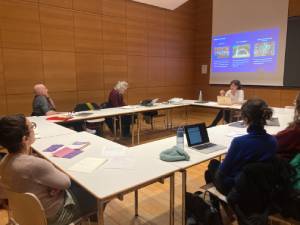
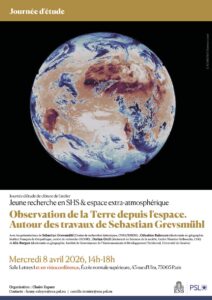
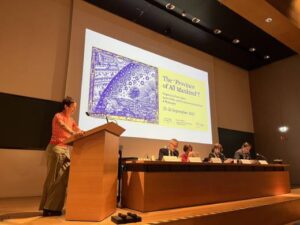
On November 21, the Space Chair participated in a workshop organized at the Collège de France by Périg Pitrou, anthropologist and director of research at the CNRS. This workshop brought together several teams and research project leaders in the social sciences and humanities working on outer space from different European countries with the aim of developing future collaborations.
Perig Pitrou began by reviewing the projects that his “Anthropology of Life” team is working on, thanks to the support of PSL University, the Collège de France, and the CNRS. On the one hand, the Off-Earth Atlas project, conducted in partnership with University College London and the Maison Française d’Oxford. On the other hand, the social sciences and humanities component of the PEPR Origins project, which focuses on definitions of life in exobiology.
Nina Klimburg-Witjes, from the University of Vienna, then presented her ongoing ERC Starting Grant project, FutureSpace, which aims to map the institutional and industrial narratives that accompany the development of the Ariane rocket, as well as the sometimes contradictory imaginaries in a context of increased global competition.
Victor Buchli, from University College London, presented the findings of his ERC Advanced Grant project EthnoISS, which developed an ethnography of an “extraterrestrial society,” the International Space Station. His research shows how microgravity reconfigures our ways of communicating, our perception of the body and materiality, but also our coexistence and spiritual and religious practices, which take on new meaning when earthly reference points disappear.
Stéphanie Ruphy, director of the Space Chair, and the entire chair team, after presenting their work in progress, also had the opportunity to exchange ideas with members of the Institute for Space at the University of Leicester, where a new SHS research team is being set up.
The workshop highlighted the vitality and strong growth of SSH research on outer space in various European countries, and the value of bringing these research communities together at the European level.