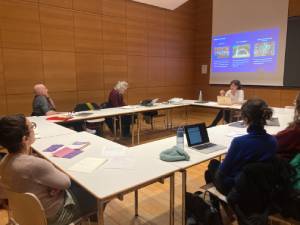
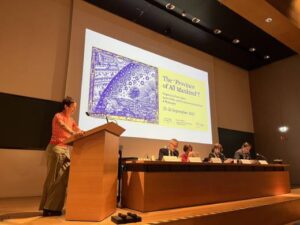
Work environment and research topics
Its research activities will be structured around three axes (described in more detail here).
– First axis: diversification of uses of outer space, evolution of representations of space, in particular in connection with these new uses and with developments in scientific knowledge of the solar system and beyond (discoveries of exoplanets, space exploration missions to other planets in the solar system, etc.).
– Second axis: how can we conceive of space as a “territory or common good” for humanity, and what are the resulting tensions? The Chair is particularly interested in the following double tension: tension between the ambition of a common good and the logic of commercial appropriation (of natural resources and of space as a circulation zone); tension between the ambition of a common good and the use of space as a stake and lever of sovereignty. In other words, how can we ensure that space emerges as a common good, in the economic and legal sense, in the face of, on the one hand, the multiplication of private uses of space and, on the other, the ambitions of states?
– Third axis: What contribution can space make to preserving the planet? And what sustainable uses of space?
The Chair’s activities are characterized by a broad spectrum of interdisciplinarity, reflected in the diversity of PSL University’s research communities(CERES, CIENS, CIEE, ENS Geosciences Department, ENS Chair in Geopolitics of Risk, Observatoire de Paris), which are directly involved in the Chair via its scientific steering committee.
The Space Chair offices are located on the ENS rue d’Ulm campus, in the fifth arrondissement of Paris. The doctoral student will be attached to one of the ENS laboratories (or another PSL establishment), depending on his/her profile.
Candidate profile
Candidates must hold a Master’s degree (or obtain one by September 2024 at the latest) in one of the disciplines relevant to the Chair’s research themes (economics, history, geopolitics, political science, philosophy, law, sociology, cybersecurity, geosciences and climate and environmental sciences, earth sciences, etc.).
Ability to work within a multidisciplinary project is expected.
To apply – Deadline May 20, 2024
Required documents:
– CV
– Copies of examination results for relevant degrees obtained
– A letter of application detailing the applicant’s motivation to join the Space Chair research team and the suitability of his/her profile.
– A detailed thesis proposal (6 to 10 pages, 1.5 times new roman 12 line spacing) (question, hypotheses, state of the art, corpus studied, methodology, thesis objectives + inclusion of the thesis in one of the Chair’s research areas, and stages envisaged for its completion, bibliographical references).
– Two letters of recommendation (to be sent directly to the addresses below)
– A written sample of scientific production (e.g. Master’s thesis)
The application form should be sent (in a single pdf file) to stephanie.ruphy@ens.psl.eu (scientific director of the chair) and stephanie.braquehais@ens.psl.eu (project manager).
The successful candidate must be enrolled in an ENS / PSL doctoral school, according to his/her profile and thesis subject, and meet the conditions required by the doctoral school concerned for doctoral students.