How can anthropologists study outer space?
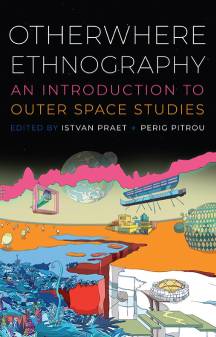
This is the question posed by Perig Pitrou (CNRS, Collège de France, PSL University) and Istvan Praet (Durham University) in their book Otherwhere Ethnography: An Introduction to Outer Space Studies.
Bringing together anthropologists, science historians, and STS researchers, this collective project offers an interdisciplinary reflection on ways of understanding and thinking about space.
On Monday, October 6, the book’s two editors were at the ENS to discuss the topic with Susie Pottier, a postdoctoral researcher at the ENS–PSL Space Chair.
One of the main themes of the discussion was the notion of boundaries, which can take many forms: geophysical, legal, symbolic, but also scientific. While space alone was seen as an absolute discontinuity, Istvan Praet recalled how astrobiologists challenged this view by describing the Earth’s past and eras as radically different worlds.
A photograph illustrates this point. It shows the Spirit probe, its front wheels resting at the foot of Columbia Hills in the Goussev crater—bearing the remains of a past when Mars had conditions similar to those on Earth—while its rear wheels are still on the plain, which is deserted, cold, and hostile to life, corresponding to the Mars we know today. At this key moment, fleetingly captured in an in-between state where the boundaries are no longer spatial but temporal, we are invited to consider them from multiple angles.
Another common thread in the discussions was the plurality of space—in its representations, practices, and uses. Anthropology allows us to question the distinctions usually taken for granted between the terrestrial and the extraterrestrial, or the living and the non-living. Space does not appear as a homogeneous place, but as a multiple space.
Susie Pottier cited how, in Chapter 7, the bonds formed between astronauts and the plants grown aboard the International Space Station create new symbolism and new narratives. Growing plants on the ISS, often presented as a sign of a sustainable future for humanity and the breeding ground for deep space exploration, redefines our ways of thinking about the continuity of life and the possibility of habitable worlds.
Still marginal ten years ago, spatial anthropology covers new avenues for approaching space with “reflective optimism,” pluralizing perspectives, knowledge, and techniques. In these ethnographies of elsewhere, where the relationships between Earth and cosmos, human and non-human, living and technical are being redefined, space no longer appears as a place to be conquered, but as a common good, traversed by practices, borders, and cosmologies that, in turn, re-examine the way we inhabit the planet.